PeaceHealth Sponsored Capstone
As part of my University of Washington iSchool capstone, my team worked with PeaceHealth, one of the largest nonprofit health systems in the Pacific Northwest. Dr. Keith, a Sound Physicians hospitalist treating sepsis cases firsthand at PeaceHealth, brought us one of the hospital's most persistent problems: sepsis patients return at higher rates than almost any other condition, and the current system leaves critical gaps.
The objective was clear: build a post-discharge tool that helps patients catch early warning signs of infection, ultimately lowering sepsis readmission rates.
Industry average: 68
My developers’ estimate: well past the deadline
Patent application underway
Sepsis is one of the highest-readmission conditions in healthcare. 1 in 5 patients return within 30 days; within 90 days, that climbs to 1 in 3. Hospitals equip patients with everything they need to recover at home: a multi-page After Visit Summary, verbal instructions, and medication lists. The problem isn't access to information, it's retention. Patients say "yes, I understand" during discharge, but within minutes of walking out the door, they forget almost all of it. There's no system in place to reinforce that information once they're gone.
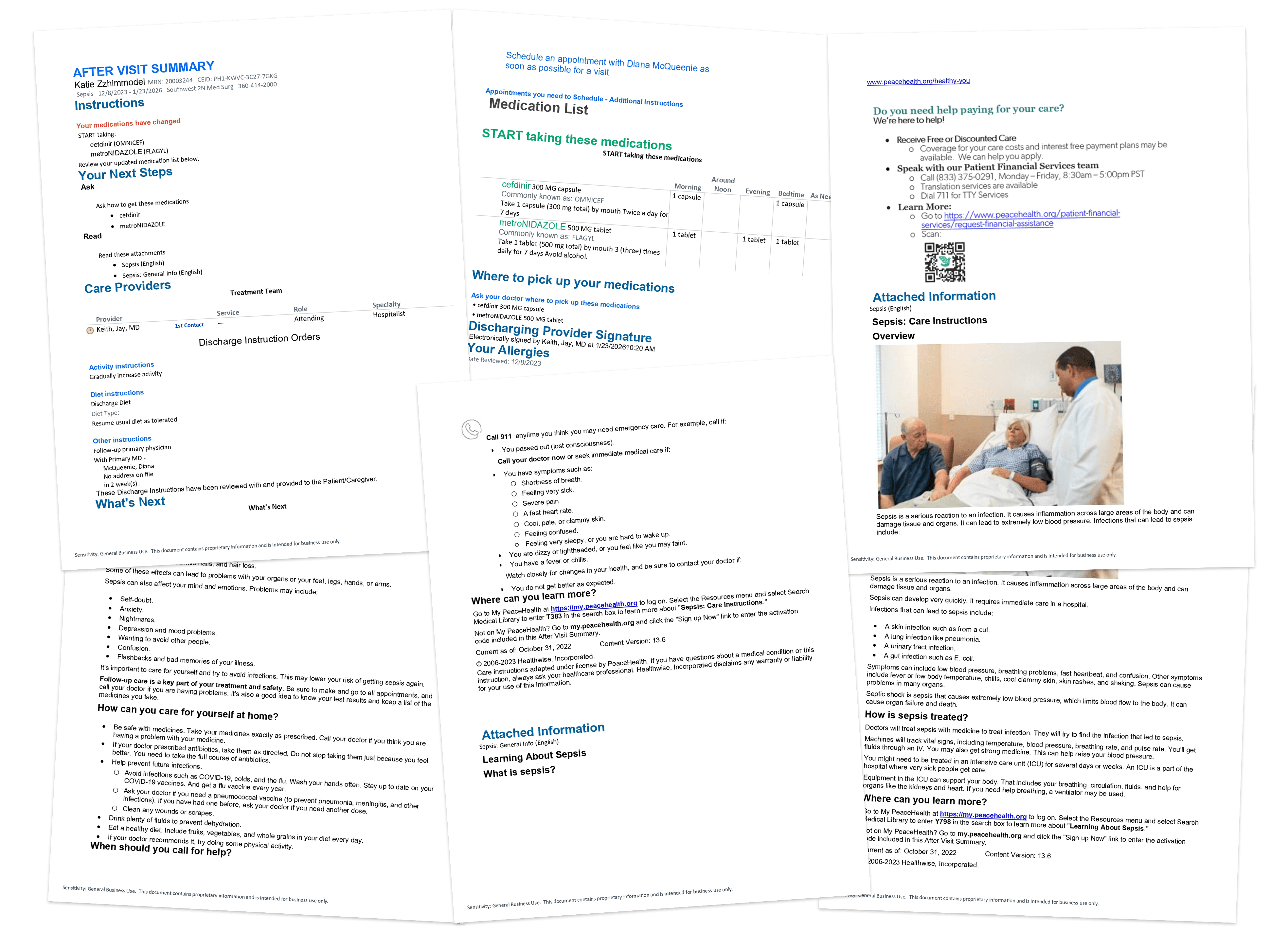
"I thought I understood everything at the hospital, but realized I was confused once I got home." - Sepsis survivor
Sepsis recovery starts here. Tillage helps patients and their caregivers learn about key warning signs, assess daily risk levels, and detect possible recurrences early, replacing a stack of paper with an active, ongoing companion for recovery.
Yale School of Nursing, 2017
PMC10546999, 2023
PMC9482946, 2022
Each team member brainstormed individually before we converged, generating 40+ ideas. My ideas focused on reducing cognitive load during check-ins, extending support to caregivers, and reinforcing recovery through active engagement, all of which were directly informed by the research insights.
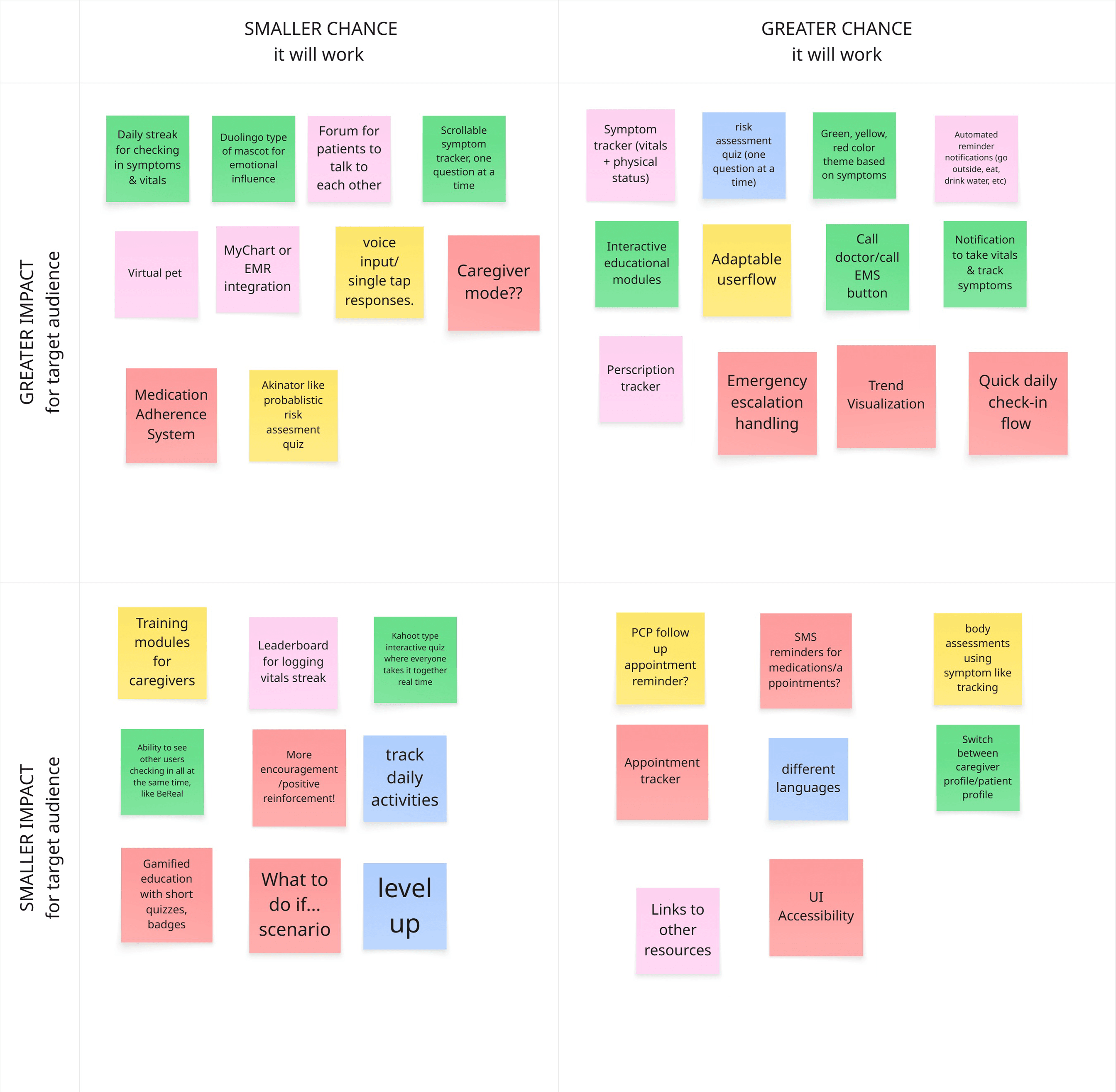
From the matrix, I sorted features into three tiers. Through iterative discussions with my team and Dr. Keith, I focused the P0 scope on daily risk assessment, education, and reminders, features that directly address the retention gap, cognitive load, and the lack of at-home monitoring identified in our research. I documented remaining features for future phases.
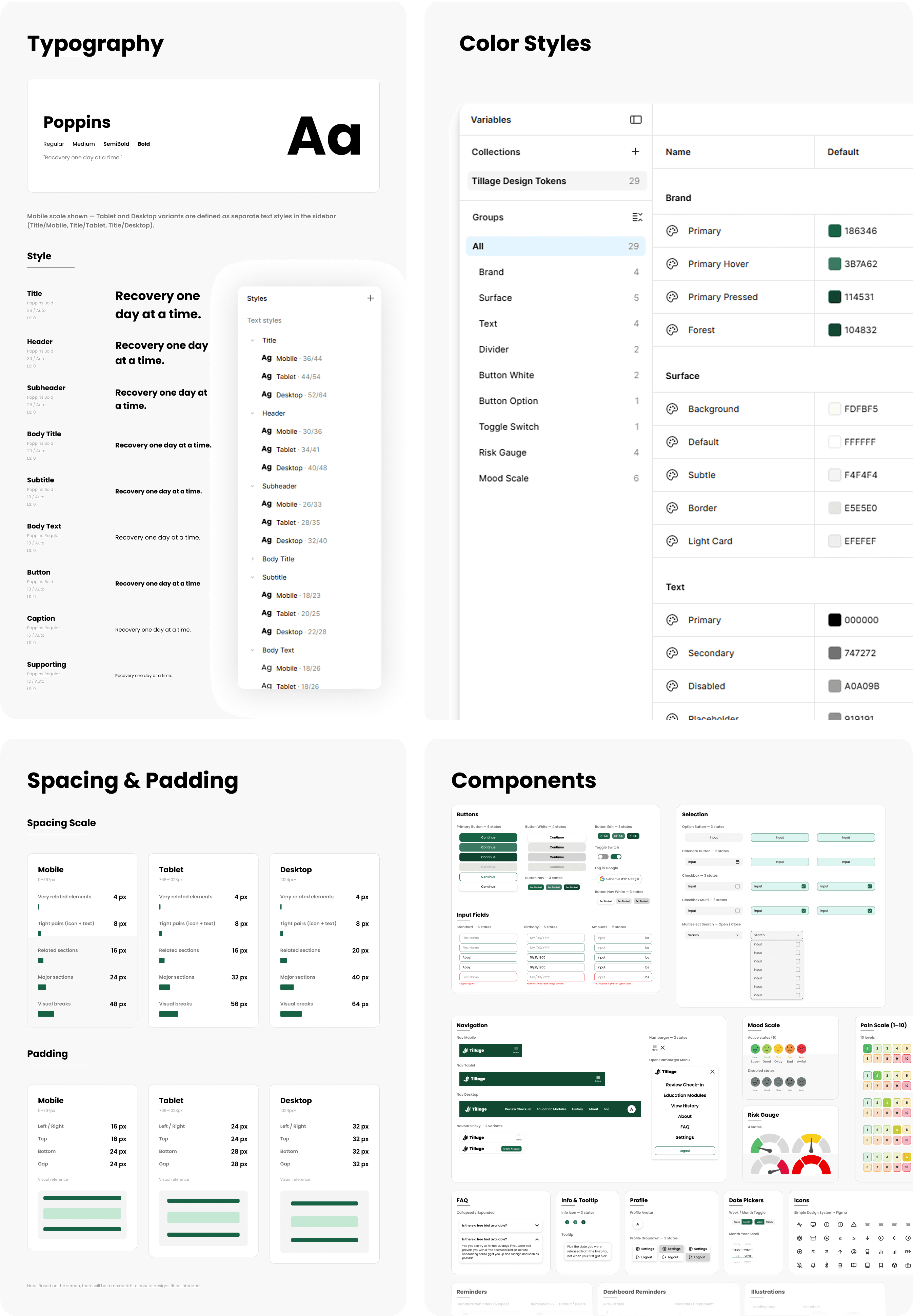
Since no direct competitors or reference patterns existed for post-discharge sepsis recovery, I started by setting ground rules: typography, color, spacing, breakpoints, and components. The design system provided the team with a single source of truth, ensuring every component remained consistent as the product scaled to hundreds of screens.
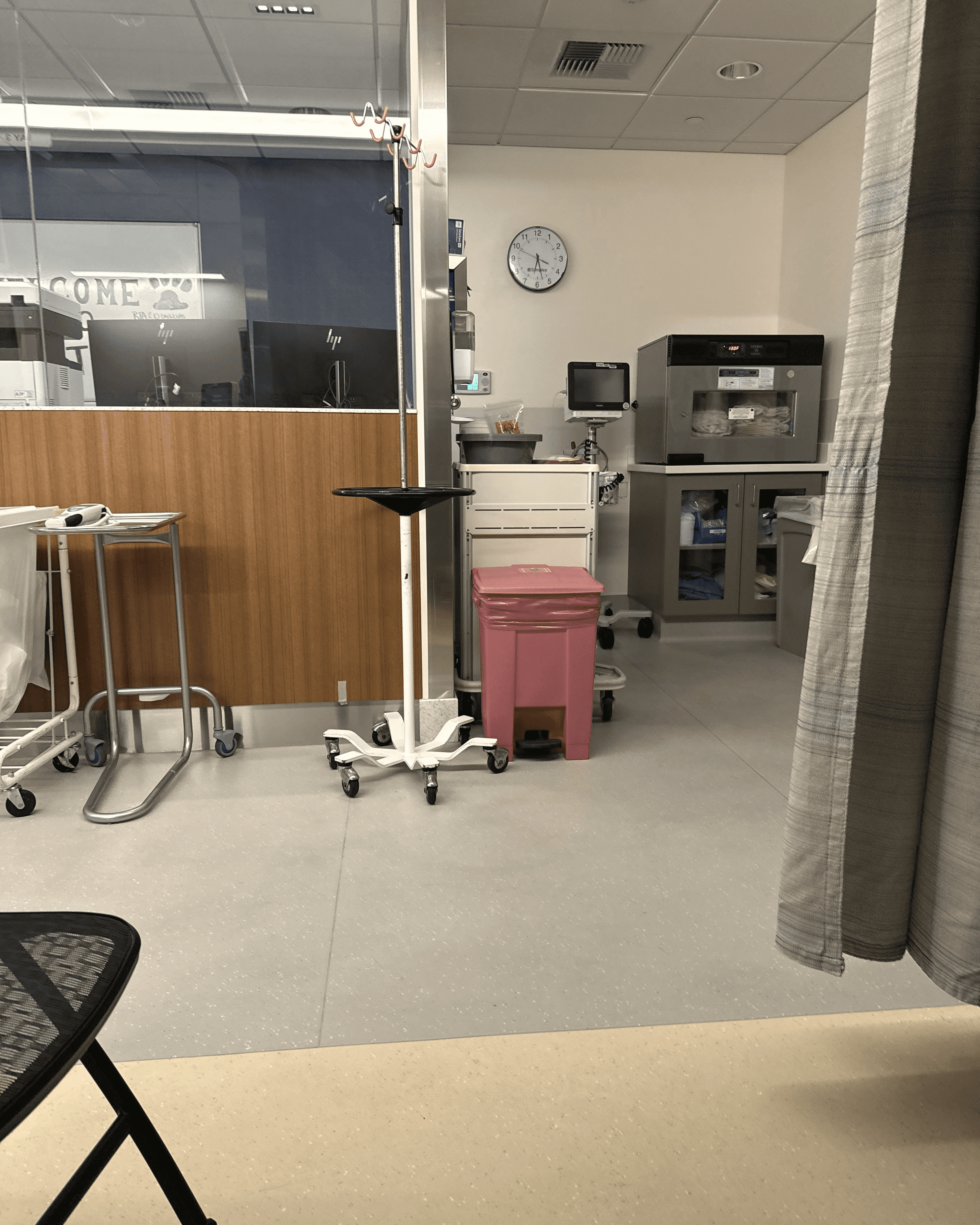
During early design, I came down with a severe fever and spent a week in and out of urgent care. The first few days, activities of daily living were a real struggle.
When the doctor walked me through recovery instructions, I followed everything in the moment. But afterward, it was very difficult to remember everything they said.
Within that state, I started thinking about design. I kept coming back to Hick's Law, which helped me see how simplicity in UI can make decisions easier, reducing cognitive load and boosting user confidence. I also made sure every piece of copy was plain and easy to understand on the first read, and designed every interaction to carry the lowest possible cognitive load.

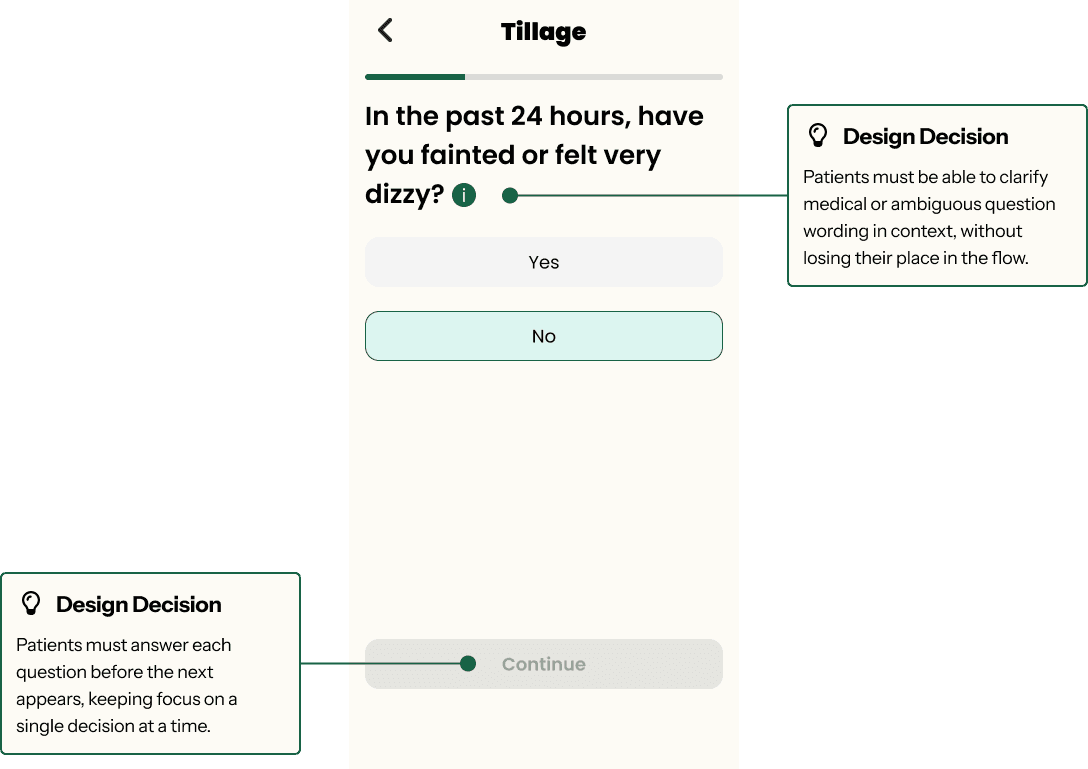
The app asks 20 onboarding questions once, then uses those answers to build each patient's daily check-in, including only the questions that apply to their conditions and equipment. Every question was reviewed with clinicians, written in plain 5th-grade language, and revised through both rounds of testing.
The clearest example: a survivor with chronic vertigo was flagged as a false emergency because "have you fainted or felt very dizzy" swept in her everyday baseline. I rescoped it to capture genuine warning signs, passing out, nearly passing out, too dizzy to stand safely, not symptoms a patient already lives with.

With the design system in place, I aligned with my teammate on three foundational screens: onboarding, the daily check-in and risk assessment, and the dashboard.
From there, I moved into mid-fi to flesh out every screen, transition, and edge case in between, getting the product ready for user testing.
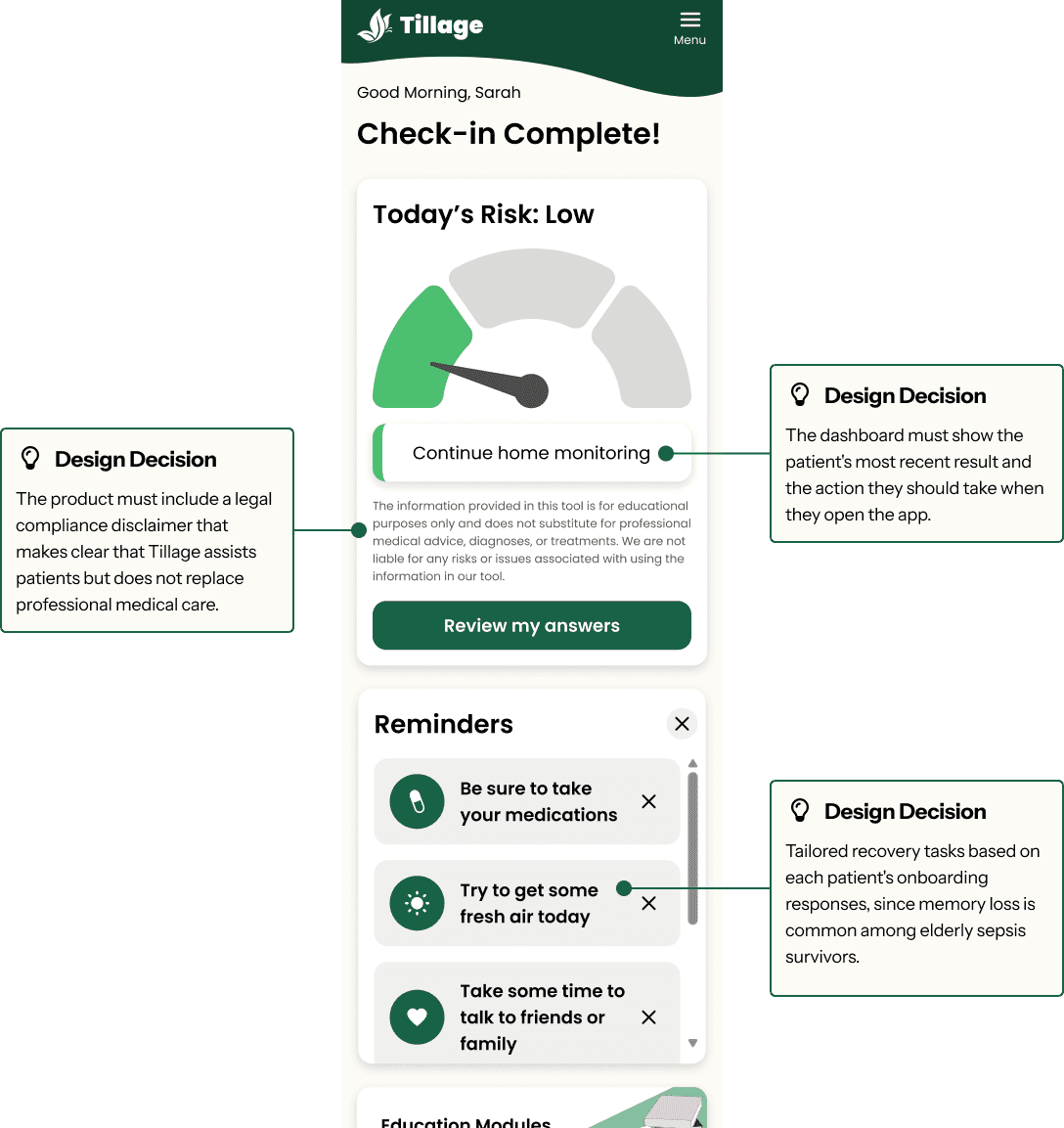
With three weeks until the MVP, no styled front end existed, and both developers were backend. I designed for handoff from the start: auto-layout, spacing tokens, component states so that the design system could double as the spec. I introduced Figma MCP to get screens to code, wrote one-shot prompts that closed the gap to the design, and ran co-op sessions with my developers to implement them. The MVP went out on deadline, and the pipeline carried every screen after it.
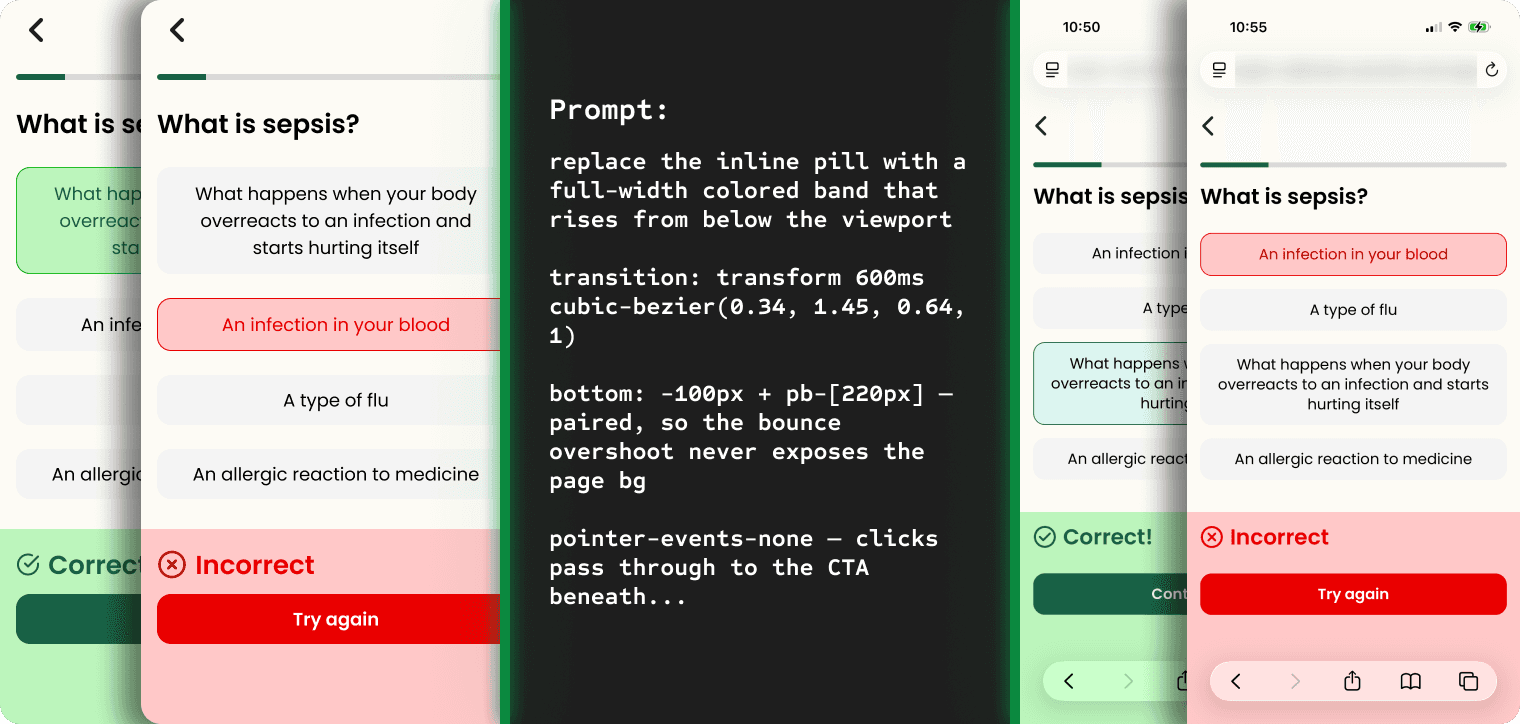
Figma MCP got screens to code fast, but the finishing details didn’t land: the exact spacing, easing, and states that make a design feel right. I fixed each one myself, iterating on my localhost until it matched the design, then distilled the verified fix into a one-shot prompt. In the next day’s co-op session, my developers ran the prompts and confirmed the backend held up. Every one landed on the first pass.

I validated the design in two rounds. First, expert reviews with a UX content expert, a doctor, and a clinical performance nurse, alongside usability testing with sepsis survivors. Each reviewer brought a different lens (content clarity, clinical accuracy, and workflow fit), surfacing the problems the iterations below solve. A second round on the finished hi-fi build, with survivors and clinical nurses, put those solutions to the test.


"Users didn't know who the app was for or why to trust it." - UX Content Expert
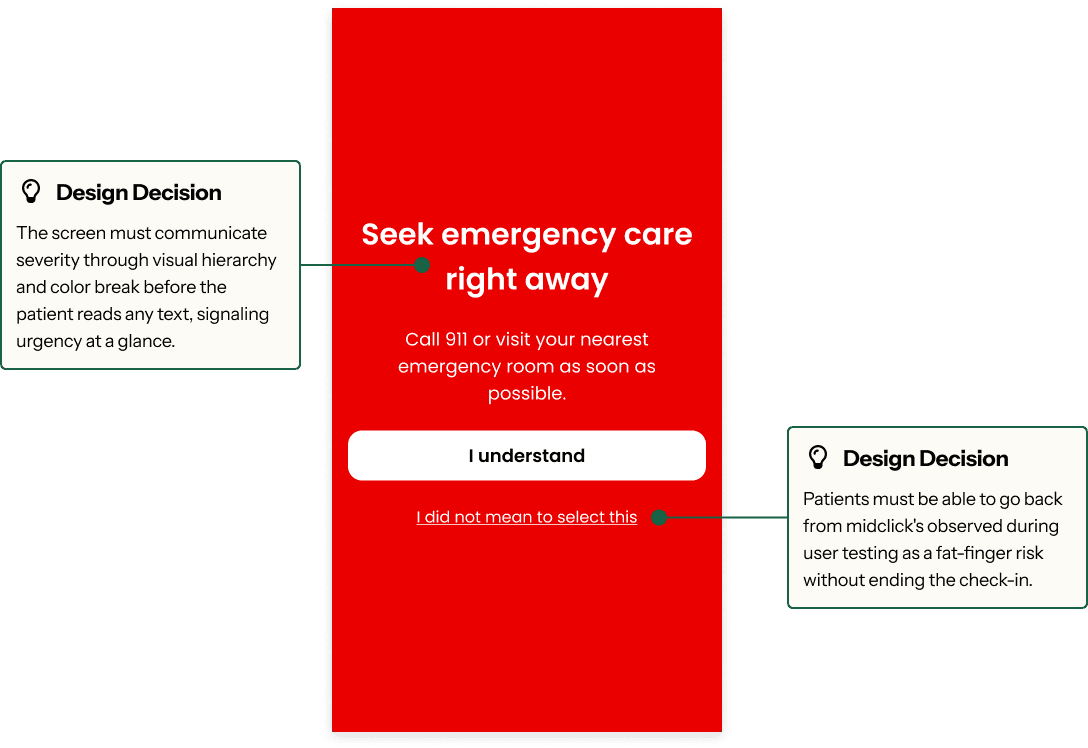
The original emergency screen was a dismissible popup in the app's green palette, easy to close and easy to underestimate. I redesigned it as a full-screen red takeover that patients must acknowledge before continuing, followed by a one-tap 911 call from the dashboard. When a survivor triggered it in round 2, they followed the escalation without hesitation.


The continuous check-in flow drained users, question after question with no sense of progress. I added labeled space screens that introduce each section, giving patients context on what's coming and a mental break between them.

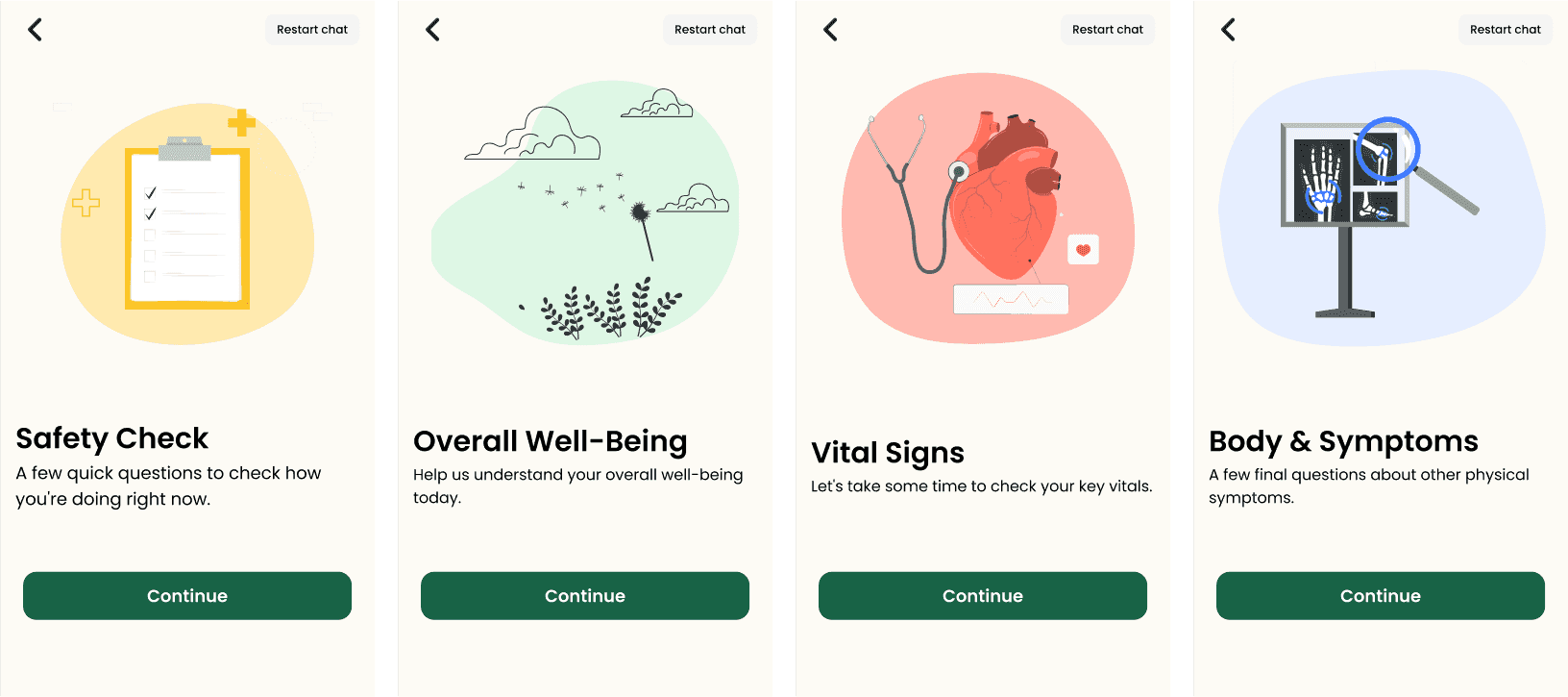
Some questions felt invasive without a reason, and others asked for unfamiliar measurements, like resting oxygen (SpO₂). I added info buttons that explain why a question matters and how to answer it: help one tap away, without cluttering the screen for patients who don't need it.


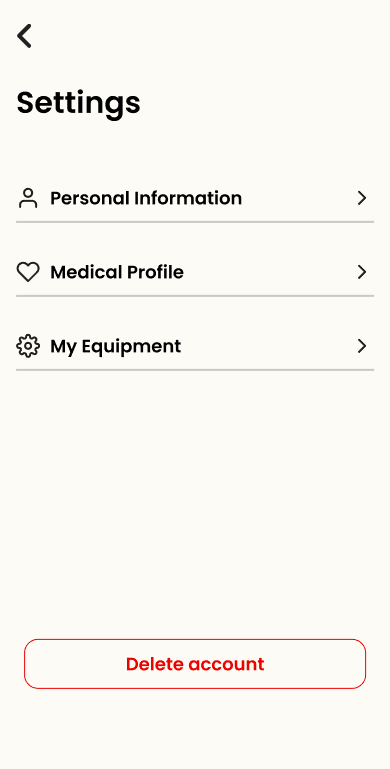
Settings began as one endless scroll, dozens of fields with no way to update one thing quickly. I restructured it into three focused sub-pages, Personal Information, Medical Profile, and My Equipment, grouped so anything a patient needs sits one tap deep instead of buried mid-scroll.

Patients check in from wherever recovery happens: a phone in bed, a tablet on the couch, a caregiver's desktop. I designed responsive states for every screen, from the dashboard to the emergency overlay, then drove them into production through co-op sessions with our developers, keeping layouts and tap targets consistent so the experience never has to be relearned between devices.

Once the app collects symptom data such as fever, chills, and vitals, it's Protected Health Information. Launching publicly required HIPAA compliance, a workstream we ran with lawyers and PeaceHealth's IRB that now continues under their team.
Any study involving patient recruitment through PeaceHealth requires Institutional Review Board (IRB) approval, a process that can take months for studies that handle Protected Health Information. Because this approval window extended beyond the capstone timeline, I couldn't recruit sepsis survivors directly through the hospital. I sourced participants independently through online sepsis survivor communities. The trade-off: a smaller, self-selected sample, but an earlier signal on the design.
We successfully met the goals our sponsor set and supported the transition with full documentation, a handoff meeting, and an open line for questions down the road. PeaceHealth and Sound Physicians are now carrying it toward clinical use.
This was my first time leading a project end-to-end, and part of it was mentoring one of our designers. After getting them up to speed on our design system and Figma fundamentals, I realized the most useful thing I could do was find what they were naturally good at and shape their part of the project around that strength.
Something I didn’t expect from this project was how much I’d grow on the engineering side. My developers owned the backend. My strength was the design eye: the spacing, sizing, and positioning that make a design feel right. The pipeline put that eye to work in code. I came in as a UX designer and left closer to a UX engineer.
Designing for people recovering from a life-threatening illness changed how I work. The time I spent with survivors taught me to design with real empathy for the person on the other end. Just as important were the people I worked with. Everyone brought different strengths, so we rarely hit gaps. The communication and chemistry made even the hardest obstacles fun. This was the best team I've been a part of.
