HCDE Directed Research
HCDE Directed Research
Timeline Control for AI agents
Timeline Control for AI agents
Timeline Control for AI agents
A UW directed research group designing the future of human to AI agent interaction.
Project overview
Project overview
A UW directed research group designing the future of human-AI agent interaction.
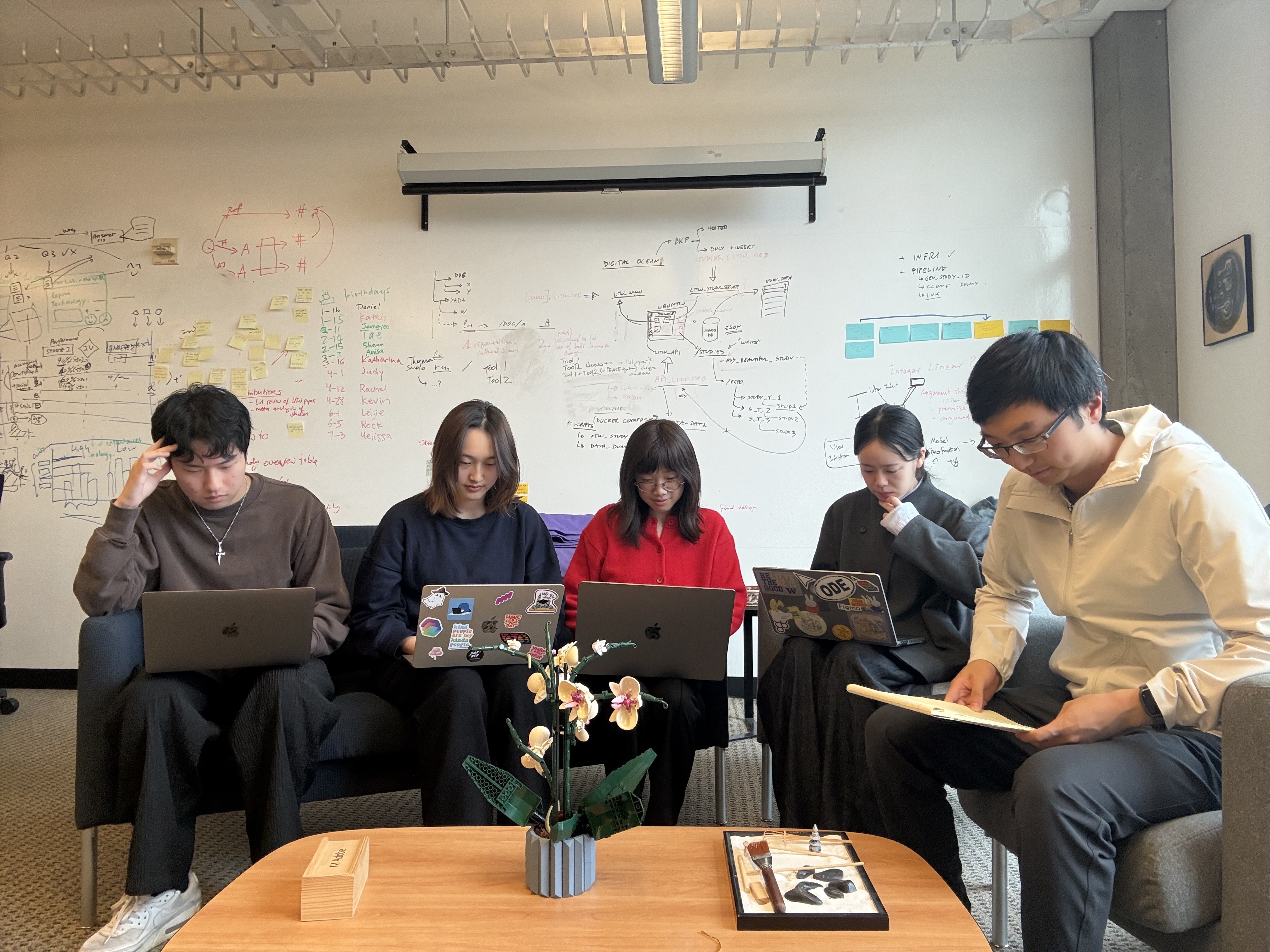
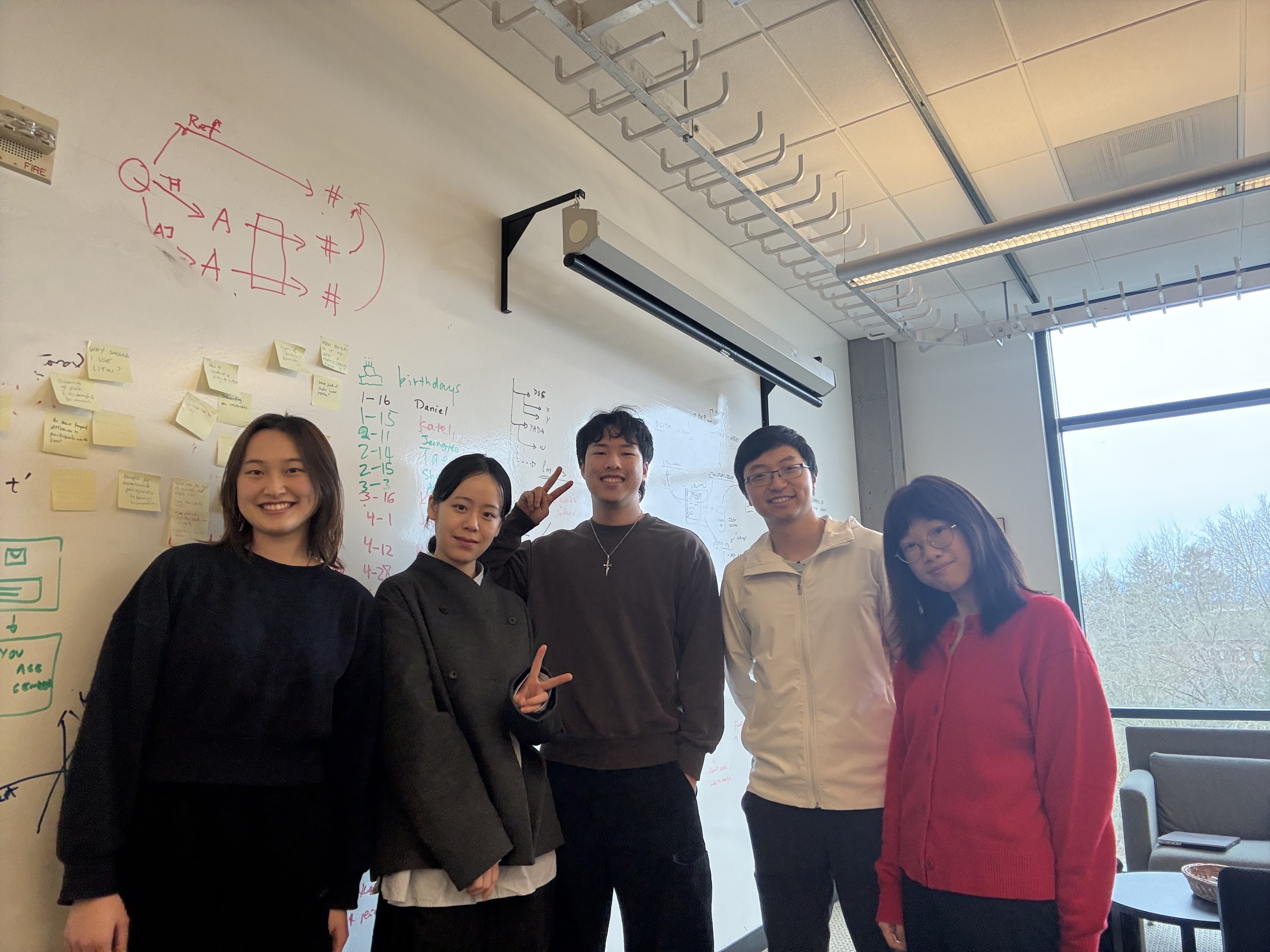
I worked with the HCDE directed research group, led by Ph.D. student Kevin Feng and Professor David McDonald, to design the future of “Human-agent interaction”. As Agents may usher in the next wave of AI and UX innovation after today’s chatbots, we wonder what the future holds for the next human-agent interaction paradigms.
Our objective was to understand the ins and outs of Human-agent interaction. We investigate through the lens of its Design challenges, solutions, and interactions, to ultimately design new interaction paradigms tailored for AI agents.
I was the only designer on this project. I worked closely with the Research Leads alongside my design peers.
We did this project quickly, with 10 weeks split: the first 5 weeks on literature review, 1 week on concept development, and the last 4 weeks on iterative design work.
I worked with the HCDE directed research group, led by Ph.D. student Kevin Feng and Professor David McDonald, to design the future of “Human-agent interaction”. As Agents may usher in the next wave of AI and UX innovation after today’s chatbots, we wonder what the future holds for the next human-agent interaction paradigms.
Our objective was to understand the ins and outs of Human-agent interaction. We investigate through the lens of its Design challenges, solutions, and interactions, to ultimately design new interaction paradigms tailored for AI agents.
I was the only designer on this project. I worked closely with the Research Leads alongside my design peers.
We did this project quickly, with 10 weeks split: the first 5 weeks on literature review, 1 week on concept development, and the last 4 weeks on iterative design work.
I worked with the HCDE directed research group, led by Ph.D. student Kevin Feng and Professor David McDonald, to design the future of “Human-agent interaction”. As Agents may usher in the next wave of AI and UX innovation after today’s chatbots, we wonder what the future holds for the next human-agent interaction paradigms.
Our objective was to understand the ins and outs of Human-agent interaction. We investigate through the lens of its Design challenges, solutions, and interactions, to ultimately design new interaction paradigms tailored for AI agents.
I was the only designer on this project. I worked closely with the Research Leads alongside my design peers.
We did this project quickly, with 10 weeks split: the first 5 weeks on literature review, 1 week on concept development, and the last 4 weeks on iterative design work.
A UW directed research group designing the future of human to AI agent interaction.
Role
Role
Role
UX Designer/
Researcher
(Sole designer)
UX Designer/ Researcher
(Sole designer)
UX Designer/
Researcher
(Sole designer)
Team
Team
Team
1 Designer
2 Research Leads
3 Design Peers
1 Designer
2 Research Leads
3 Design Peers
1 Designer
2 Research Leads
3 Design Peers
Duration
Duration
Duration
10 weeks
10 weeks
10 weeks
YEAR
YEAR
YEAR
September- December 2025
September- December 2025
September- December 2025
Research
Research
At first, we conducted a literature review of AI agents, soon discovering the limitations of Human-Agent Interaction guidelines.
At first, we conducted a literature review of AI agents, soon discovering the limitations of Human-Agent Interaction guidelines.
At first, we conducted a literature review of AI agents, soon discovering the limitations of Human-Agent Interaction guidelines.
During the research phase, we examined current methodologies used in designing AI agents. One of these methodologies was the Microsoft HAI (Human Agent Interaction) guidelines.
While the guidelines provide foundational principles and ground rules for agent design, they may not fully address the challenges posed by modern or future LLM agent paradigms with virtually infinite possible outputs.
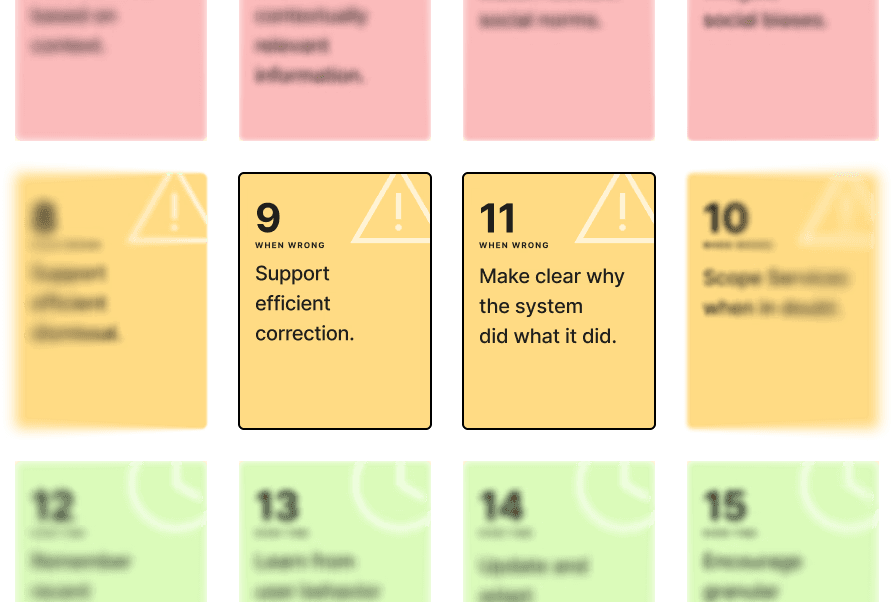
After further examination, Microsoft HAI guidelines G9 and G11 emerged as guidelines that revealed a critical gap when applied to existing systems. With the next wave of LLM agents, users can execute dozens of steps independently while walking away. These guidelines raise a gap for systems they were not designed for.
During the research phase, we examined current methodologies used in designing AI agents. One of these methodologies was the Microsoft HAI (Human Agent Interaction) guidelines.
While the guidelines provide foundational principles and ground rules for agent design, they may not fully address the challenges posed by modern or future LLM agent paradigms with virtually infinite possible outputs.
After further examination, Microsoft HAI guidelines G9 and G11 emerged as guidelines that revealed a critical gap when applied to existing systems. With the next wave of LLM agents, users can execute dozens of steps independently while walking away. These guidelines raise a gap for systems they were not designed for.
problem
problem
Current modern agents reveal critical gaps that existing guidelines fail to address
Current modern agents reveal critical gaps that existing guidelines fail to address
Current modern agents reveal critical gaps that existing guidelines fail to address
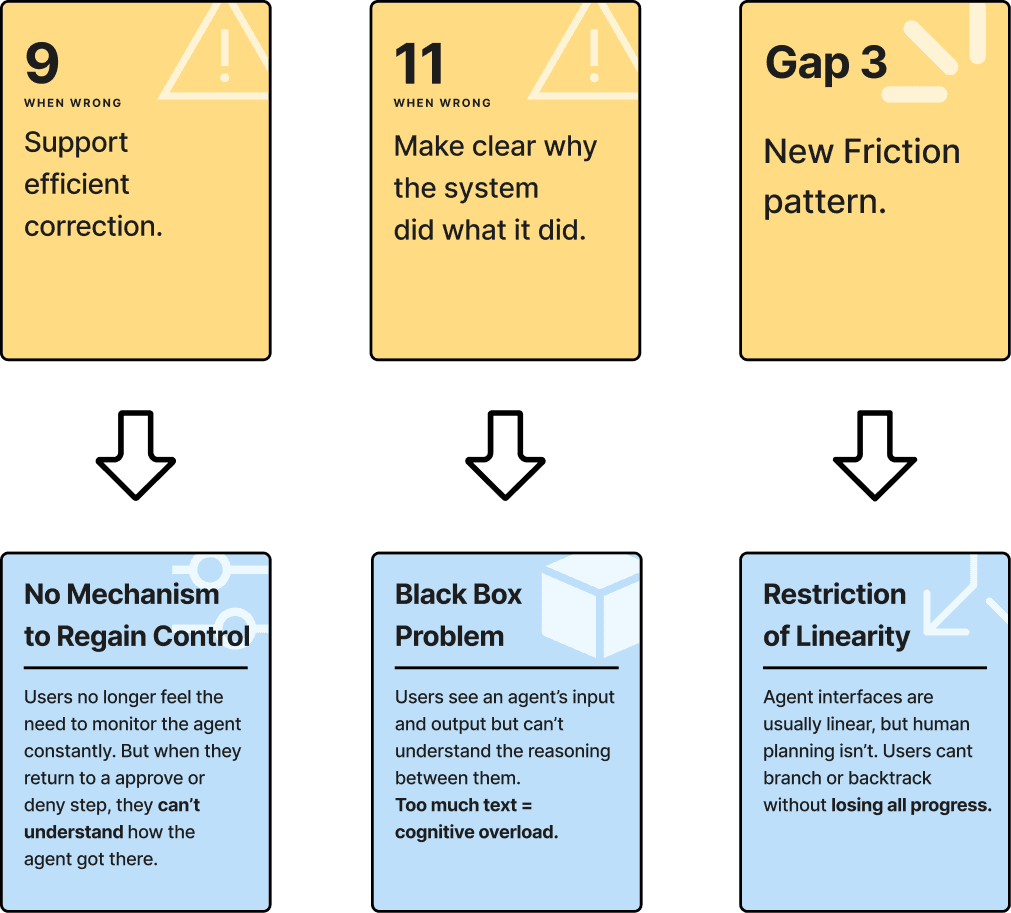
After synthesizing modern agents, conducting literature analysis, and engaging in research discussions, I identified three interconnected friction patterns. Two stem directly from Microsoft HAI guidelines, G11 and G9. The third emerged from observing tools like ChatGPT Deep Research, which lock users into a single execution path. No way to branch or backtrack without losing all progress. It was my role to discover a new interaction paradigm to address these gaps.
After synthesizing modern agents, conducting literature analysis, and engaging in research discussions, I identified three interconnected friction patterns. Two stem directly from Microsoft HAI guidelines, G11 and G9. The third emerged from observing tools like ChatGPT Deep Research, which lock users into a single execution path. No way to branch or backtrack without losing all progress. It was my role to discover a new interaction paradigm to address these gaps.
How might we help users understand, correct, and explore agent behavior even when tasks are too complex to fully grasp?
How might we help users understand, correct, and explore agent behavior even when tasks are too complex to fully grasp?
How might we help users understand, correct, and explore agent behavior even when tasks are too complex to fully grasp?
solution
solution
Introducing Timeline Control for AI Agents.
Introducing Timeline Control for AI Agents.
Introducing Timeline Control for AI Agents.
Timeline Control is an innovative version-control interface designed to address scalable oversight in the "Black box" era of autonomous agents. Using ChatGPT agent as its medium, this project introduces scrubbing, branching, and merging, further strengthening the bridge between research and taking action on the web.
Timeline Control is an innovative version-control interface designed to address scalable oversight in the "Black box" era of autonomous agents. Using ChatGPT agent as its medium, this project introduces scrubbing, branching, and merging, further strengthening the bridge between research and taking action on the web.
Scrub through the agent like a video playback.
Scrub through the agent like a video playback.
Scrub through the agent like a video playback.
Users prompt the agent and watch it build a plan in real time. The plan history displays completed steps, current execution, and upcoming actions. Users can scrub the video playback and branch from any point into a new direction.
Users prompt the agent and watch it build a plan in real time. The plan history displays completed steps, current execution, and upcoming actions. Users can scrub the video playback and branch from any point into a new direction.
Parallel branching lets users explore multiple directions at once.
Parallel branching lets users explore multiple directions at once.
Parallel branching lets users explore multiple directions at once.
From a past chapter, users unlock branch mode and prompt a new direction. The plan history expands into a branch tree, showing the separate timeline branching from the main timeline. Both agents execute in parallel, exploring two timelines.
From a past chapter, users unlock branch mode and prompt a new direction. The plan history expands into a branch tree, showing the separate timeline branching from the main timeline. Both agents execute in parallel, exploring two timelines.
Manage parallel agents like switching tabs.
Manage parallel agents like switching tabs.
Manage parallel agents like switching tabs.
Users click between branches in the current view panel. The agent's visual browser and plan history are updated instantly, showing each branch's progress and chapters without losing context.
Users click between branches in the current view panel. The agent's visual browser and plan history are updated instantly, showing each branch's progress and chapters without losing context.
Click the connections between steps to reveal the agent’s reasoning.
Click the connections between steps to reveal the agent’s reasoning.
Click the connections between steps to reveal the agent’s reasoning.
Clicking the connection between two nodes in the plan history reveals a tooltip with the agent's rationale. Users no longer see just input and output; they know the reasoning that connects them.
Clicking the connection between two nodes in the plan history reveals a tooltip with the agent's rationale. Users no longer see just input and output; they know the reasoning that connects them.
One click expands the plan history into a detailed breakdown.
One click expands the plan history into a detailed breakdown.
One click expands the plan history into a detailed breakdown.
The expand button transforms the plan history into a comprehensive view. Users can inspect any chapter in depth, revealing a complete rationale behind what the agent did, why it did it, and what it considered along the way.
The expand button transforms the plan history into a comprehensive view. Users can inspect any chapter in depth, revealing a complete rationale behind what the agent did, why it did it, and what it considered along the way.
Drag one branch onto another to begin a merge.
Drag one branch onto another to begin a merge.
Drag one branch onto another to begin a merge.
Dragging the one branch onto another triggers a merge preview. The expanded plan history shows which chapters will be replaced, struck through in red. Locked chapters indicate hard constraints; clicking the lock explains why that chapter must be removed for the merge to work.
Dragging the one branch onto another triggers a merge preview. The expanded plan history shows which chapters will be replaced, struck through in red. Locked chapters indicate hard constraints; clicking the lock explains why that chapter must be removed for the merge to work.
Customize your merge, choose what stays and what goes.
Customize your merge, choose what stays and what goes.
Customize your merge, choose what stays and what goes.
Chapters without a lock can be toggled. Clicking the minus symbol offers two options: add or remove. Adding a removed chapter turns it green but triggers a trade-off, turning the other chapter red. A final confirmation pop-up summarizes the changes and any costs before you commit. One click, and the branches become a single, unified plan.
Chapters without a lock can be toggled. Clicking the minus symbol offers two options: add or remove. Adding a removed chapter turns it green but triggers a trade-off, turning the other chapter red. A final confirmation pop-up summarizes the changes and any costs before you commit. One click, and the branches become a single, unified plan.
exploration: Ideation
exploration: Ideation
I prioritized solutions that were both speculative and comprehensive, selecting the MVP solution.
I prioritized solutions that were both speculative and comprehensive, selecting the MVP solution.
I prioritized solutions that were both speculative and comprehensive, selecting the MVP solution.
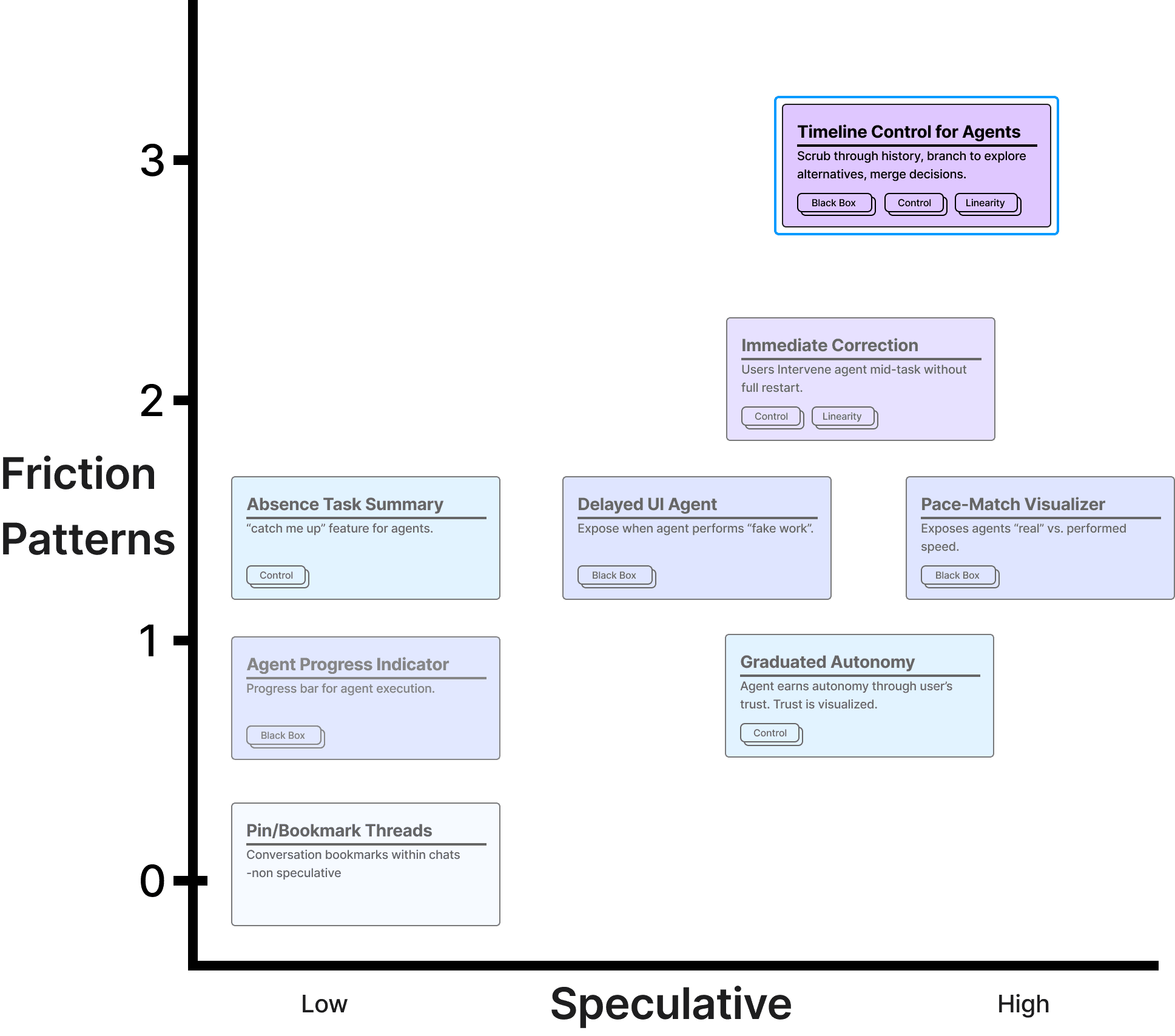
With the three friction patterns defined, I brainstormed potential solutions and graphed them by how many patterns they addressed and how novel their approach was. After mapping out possible solutions, Timeline Control for Agents emerged as the clear solution to address the entire problem space.
With the three friction patterns defined, I brainstormed potential solutions and graphed them by how many patterns they addressed and how novel their approach was. After mapping out possible solutions, Timeline Control for Agents emerged as the clear solution to address the entire problem space.
exploration: Market Research
exploration: Market Research
No direct competitors exist for agent timeline control, so I examined tools that solve pieces of the same problem.
No direct competitors exist for agent timeline control, so I examined tools that solve pieces of the same problem.
No direct competitors exist for agent timeline control, so I examined tools that solve pieces of the same problem.
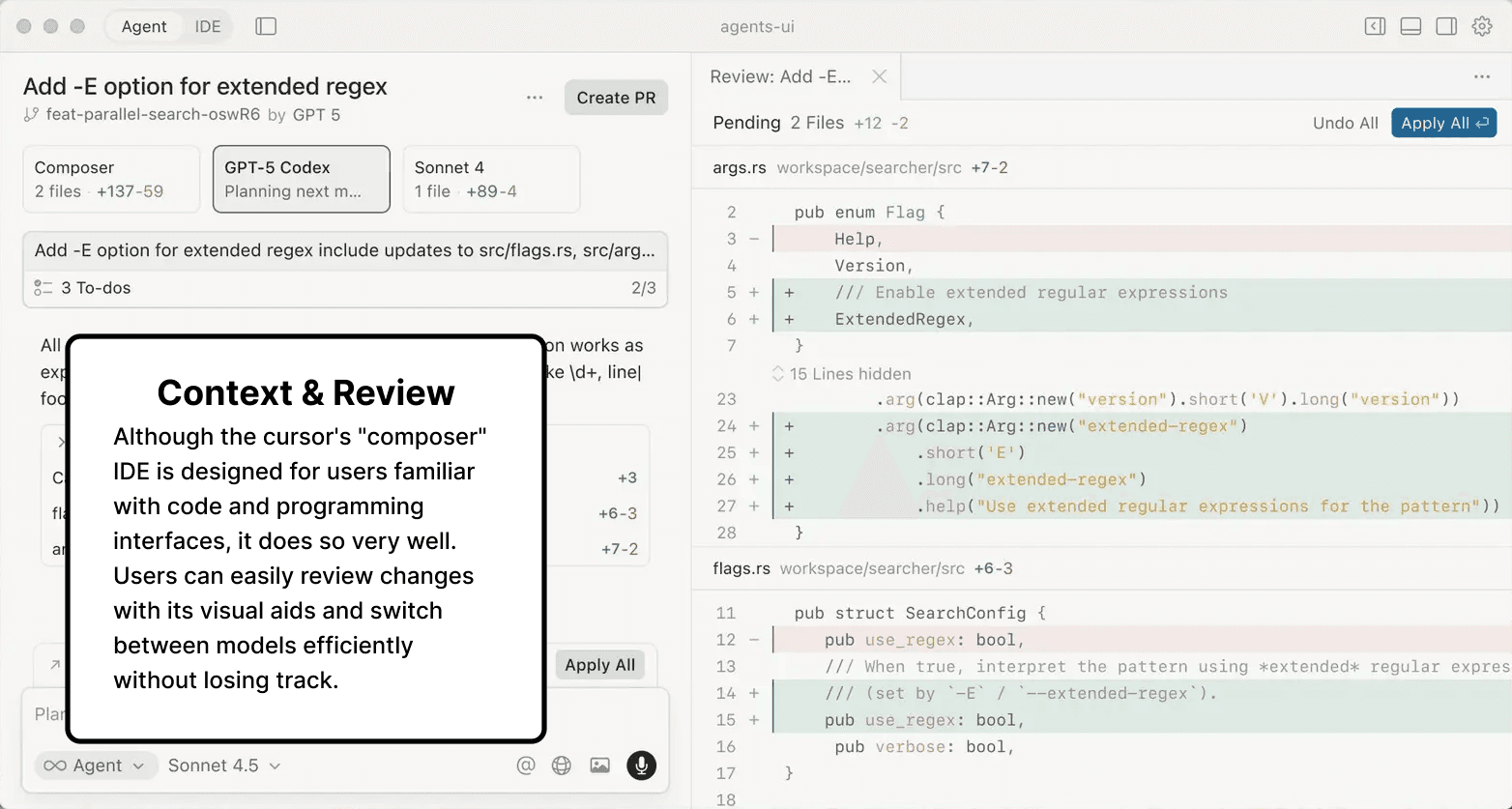
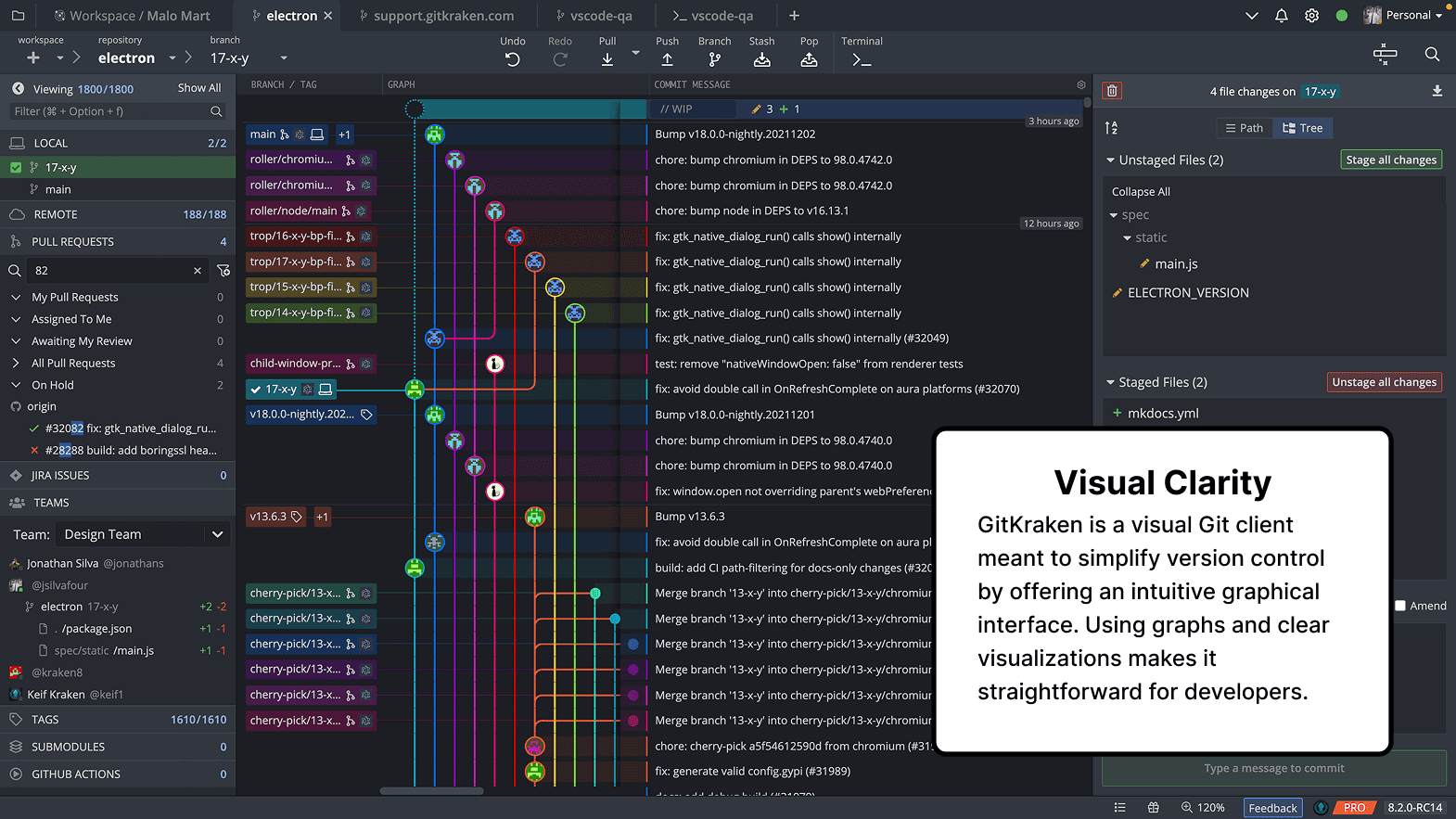
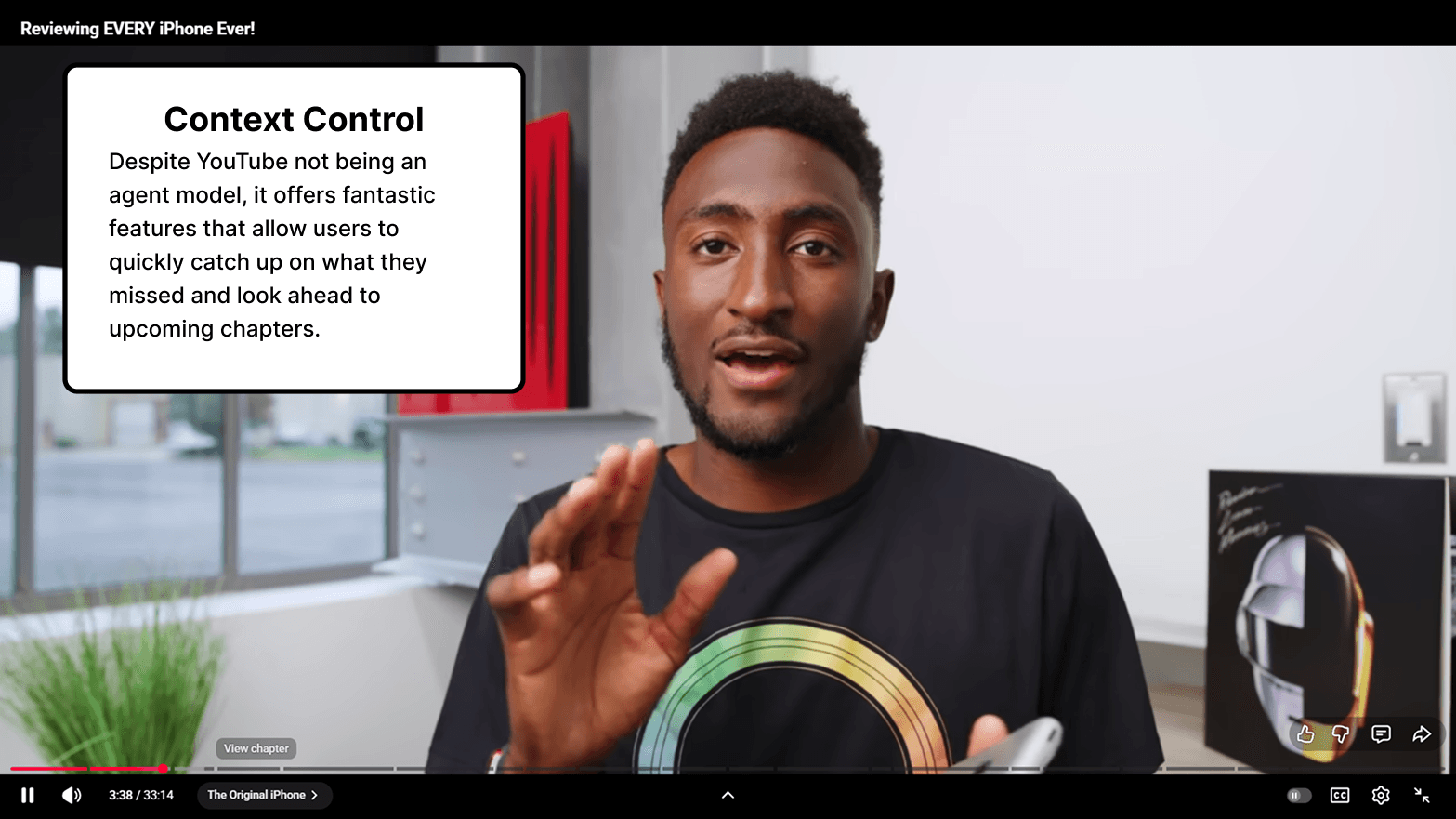
Since direct competitors for agent timeline control don't exist yet, I looked at analogous solutions. After testing a handful of products and watching videos, I identified functional design patterns that addressed key problems
Since direct competitors for agent timeline control don't exist yet, I looked at analogous solutions. After testing a handful of products and watching videos, I identified functional design patterns that addressed key problems
CONCEPT development: USERFLOW
CONCEPT development: USERFLOW
I mapped the user flow around a version control mental model.
I mapped the user flow around a version control mental model.
I mapped the user flow around a version control mental model.
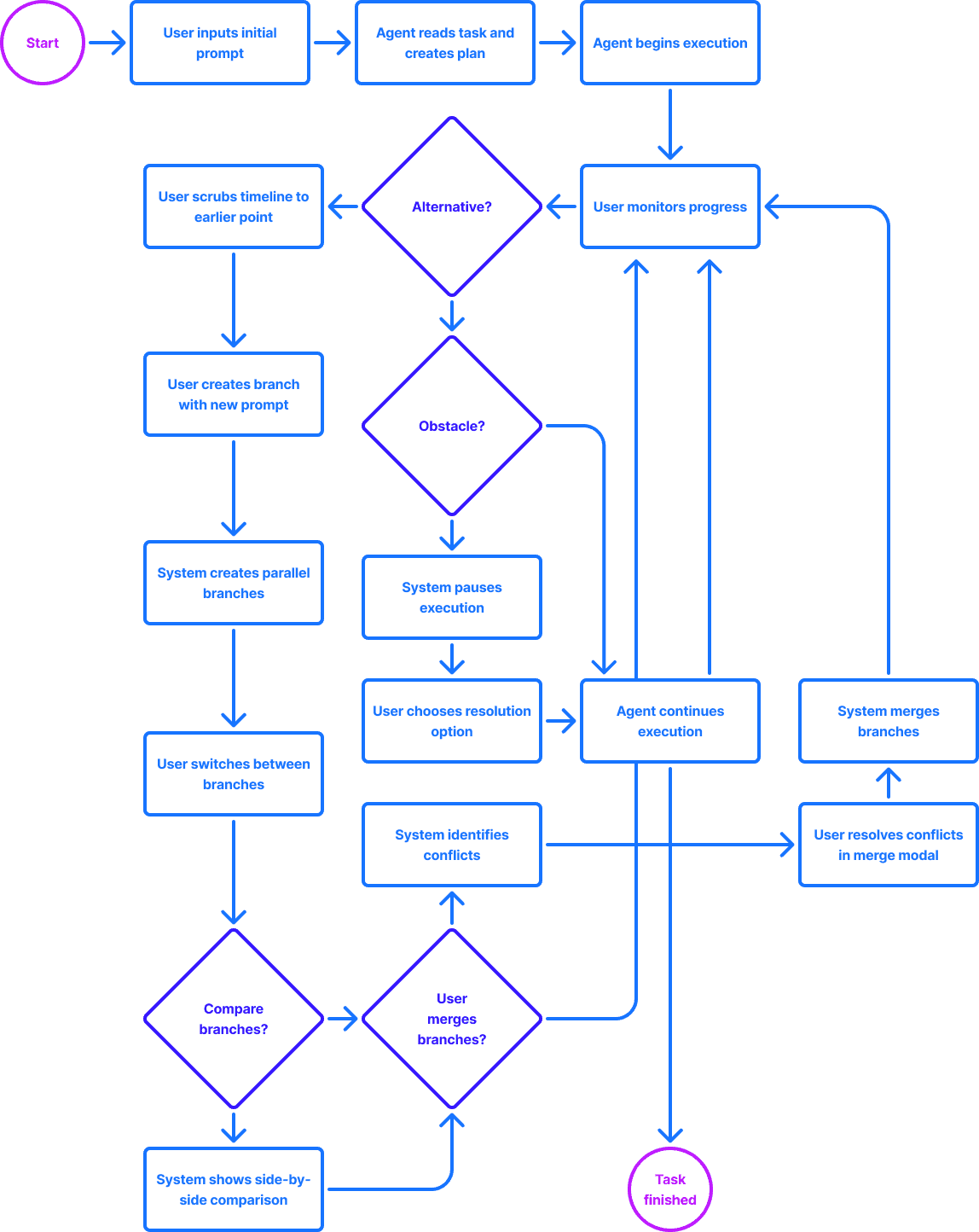
Users prompt the agent, and it decomposes the task into chapters. During execution, they monitor progress through a live view and a plan history panel. If they step away, they scrub back through the timeline to catch up. Clicking edges between steps reveals the agent's reasoning. From any past node, users can branch into an alternative direction without losing the original path, then merge the best results back into a single, unified plan.
Users prompt the agent, and it decomposes the task into chapters. During execution, they monitor progress through a live view and a plan history panel. If they step away, they scrub back through the timeline to catch up. Clicking edges between steps reveals the agent's reasoning. From any past node, users can branch into an alternative direction without losing the original path, then merge the best results back into a single, unified plan.
CONCEPT development: Lo-fi
CONCEPT development: Lo-fi
Lo-fi wireframes helped me test which ideas stood up to the actual user flow.
Lo-fi wireframes helped me test which ideas stood up to the actual user flow.
Lo-fi wireframes helped me test which ideas stood up to the actual user flow.
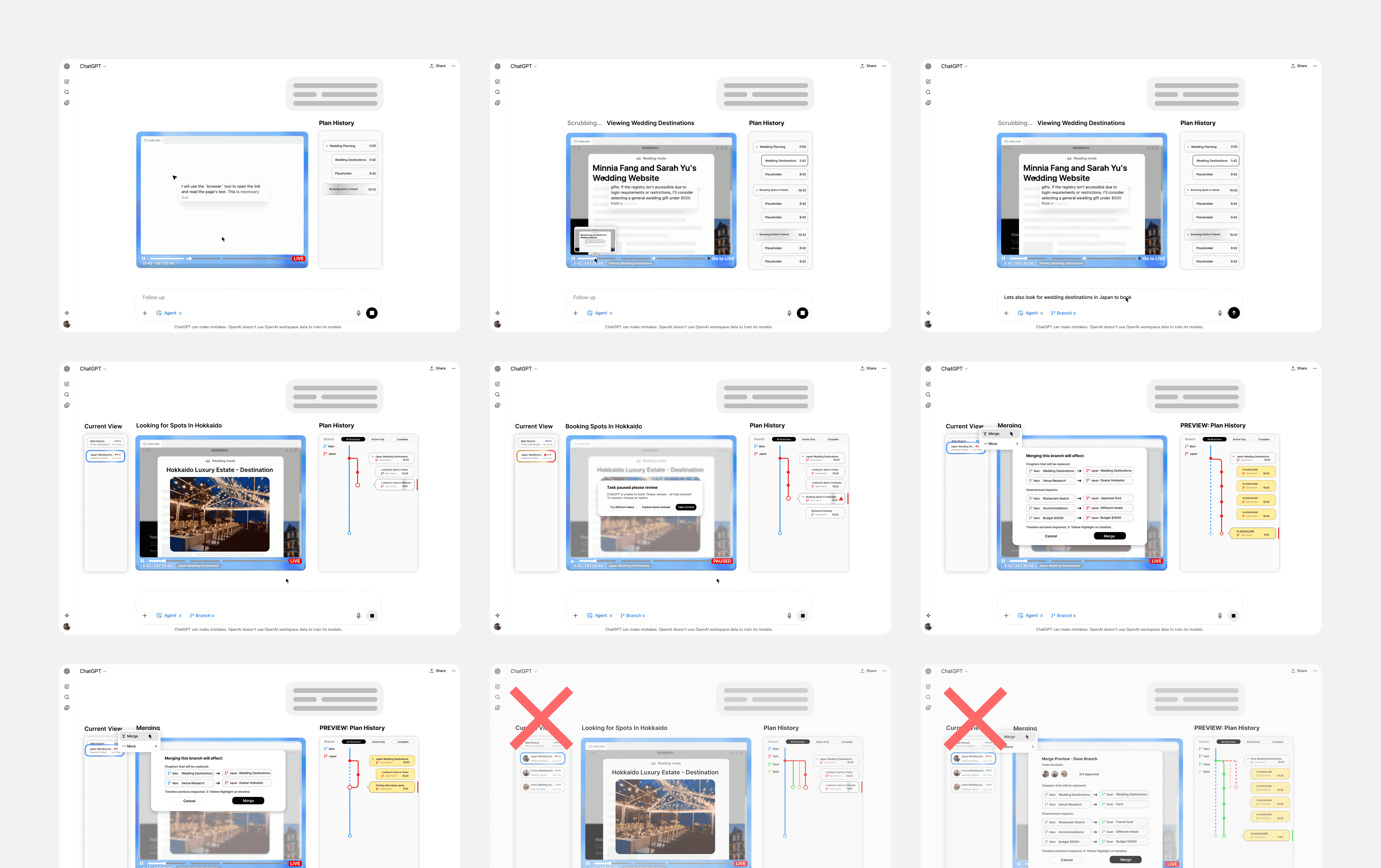
After going through sketches and brainstorming ideas, I built rough wireframes on top of ChatGPT's agent interface to keep the concept grounded. For each screen I created, I reviewed it with my team and against the mapped logic. I continued to expand on the designs that worked, and cut the ones that didn't align with the project scope.
After going through sketches and brainstorming ideas, I built rough wireframes on top of ChatGPT's agent interface to keep the concept grounded. For each screen I created, I reviewed it with my team and against the mapped logic. I continued to expand on the designs that worked, and cut the ones that didn't align with the project scope.
Expert Review: mid-fi
Expert Review: mid-fi
Expert reviews on mid-fidelity wireframes surfaced three core problems.
Expert reviews on mid-fidelity wireframes surfaced three core problems.
Expert reviews on mid-fidelity wireframes surfaced three core problems.
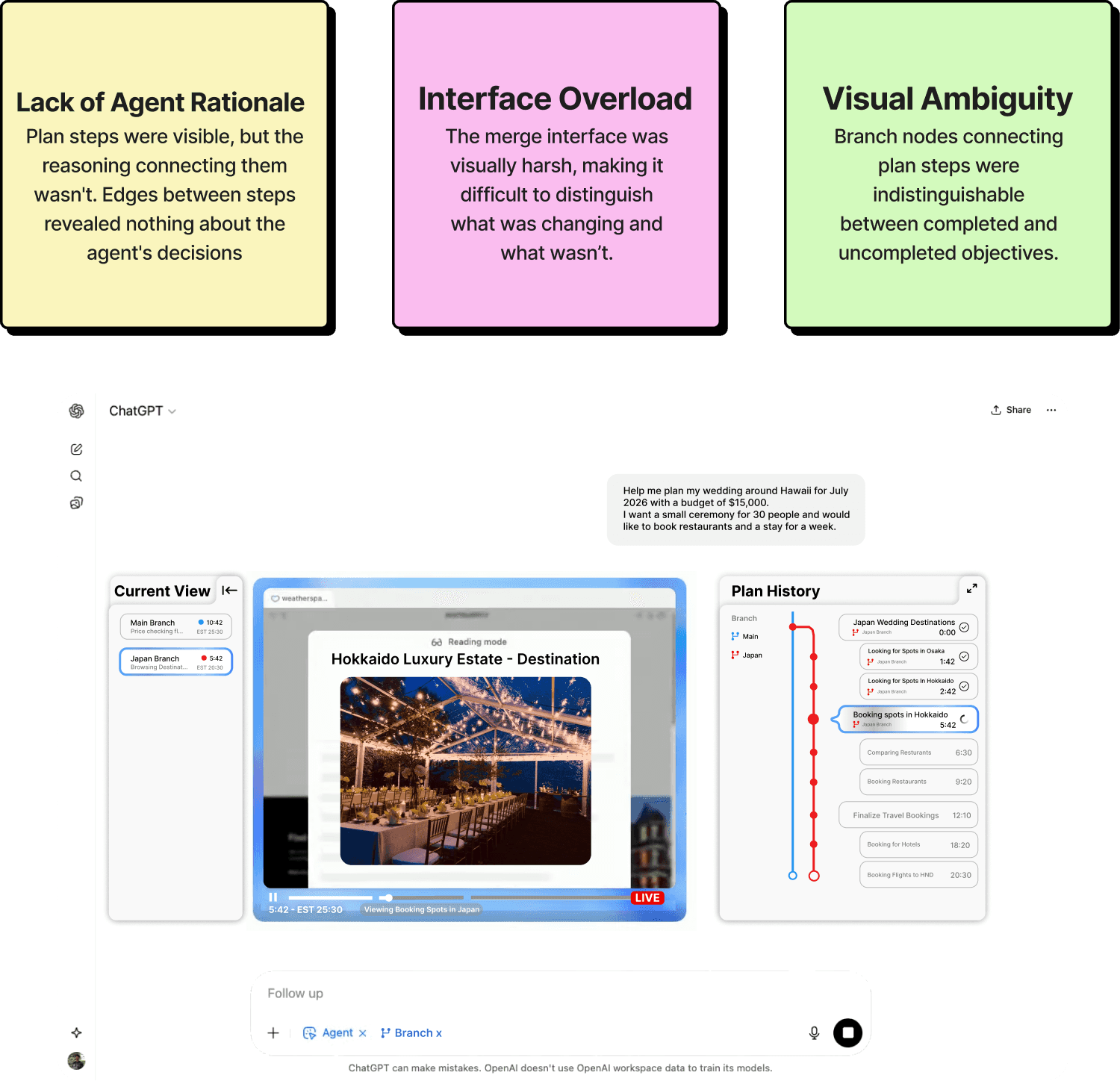
I conducted usability tests and reviewed the mid-fi prototype with my research leads. Three notable issues emerged: the plan history showed steps but not the agent’s reasoning behind them, the merge interface was visually overwhelming, and branch nodes gave no indication of completion state. Each problem identified usability gaps in clarity and feedback that needed to be addressed before moving to high fidelity.
I conducted usability tests and reviewed the mid-fi prototype with my research leads. Three notable issues emerged: the plan history showed steps but not the agent’s reasoning behind them, the merge interface was visually overwhelming, and branch nodes gave no indication of completion state. Each problem identified usability gaps in clarity and feedback that needed to be addressed before moving to high fidelity.
iteration
iteration
I addressed each problem through targeted design iterations.
I addressed each problem through targeted design iterations.
I addressed each problem through targeted design iterations.
With three usability gaps identified, I moved into high-fidelity refinement. Each iteration focused on a single issue, ensuring changes were intentional and traceable. The before-and-after comparisons below show how I resolved each problem.
With three usability gaps identified, I moved into high-fidelity refinement. Each iteration focused on a single issue, ensuring changes were intentional and traceable. The before-and-after comparisons below show how I resolved each problem.
Edges between plan chapters lacked progressive disclosure, users could see the connection but had no way to access the agents underlying decision logic.
Edges between plan chapters lacked progressive disclosure, users could see the connection but had no way to access the agents underlying decision logic.
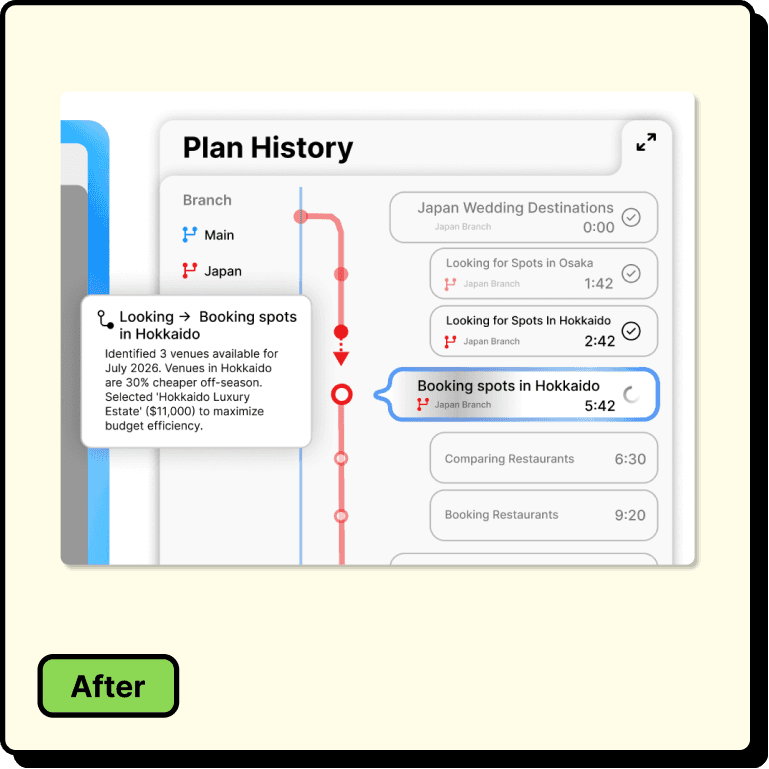
I introduced a two-tier disclosure pattern on edges: click between two nodes to reveal the agents rationale, expand for full context. This reduces cognitive load while keeping rationale accessible on demand.
I introduced a two-tier disclosure pattern on edges: click between two nodes to reveal the agents rationale, expand for full context. This reduces cognitive load while keeping rationale accessible on demand.
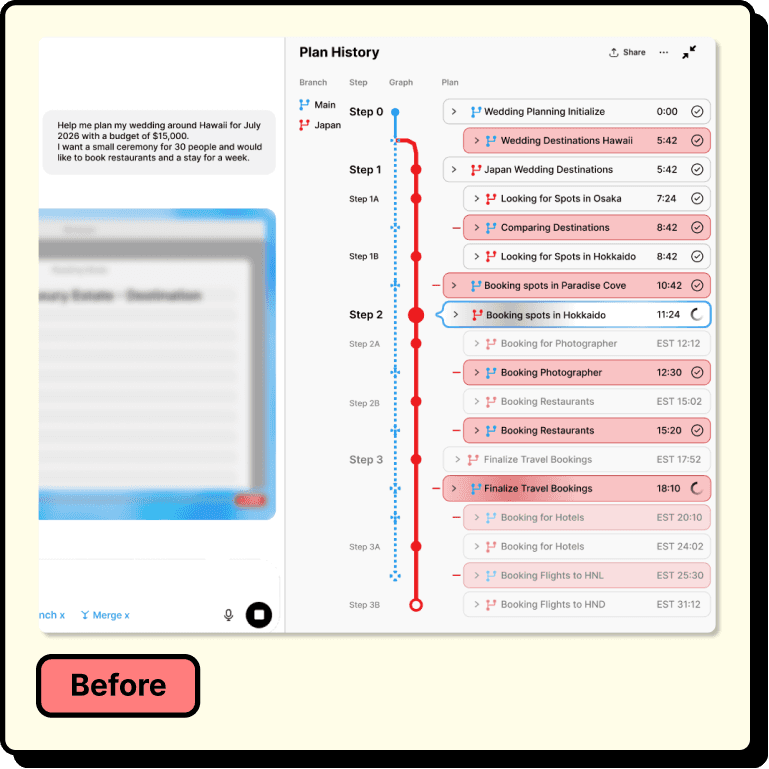
The merge interface was described as visually overwhelming, resulting in high cognitive load and a poor signal-to-noise ratio. Users had difficulty understanding the interfaces’ roles.
The merge interface was described as visually overwhelming, resulting in high cognitive load and a poor signal-to-noise ratio. Users had difficulty understanding the interfaces’ roles.
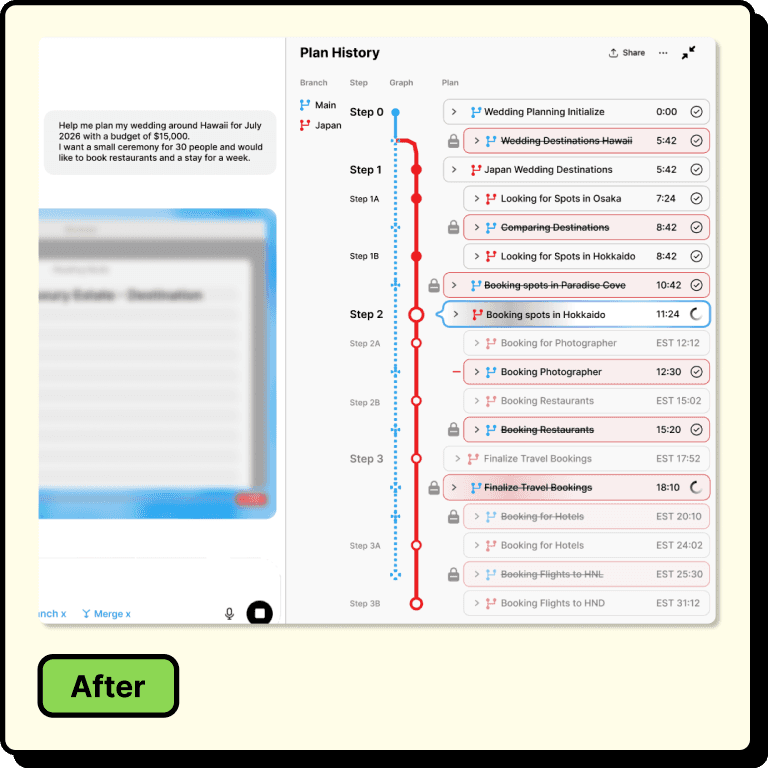
I established a clear visual hierarchy through color coding and distinctive icons. This improves scannability and reduces time-to-comprehension during conflict resolution.
I established a clear visual hierarchy through color coding and distinctive icons. This improves scannability and reduces time-to-comprehension during conflict resolution.
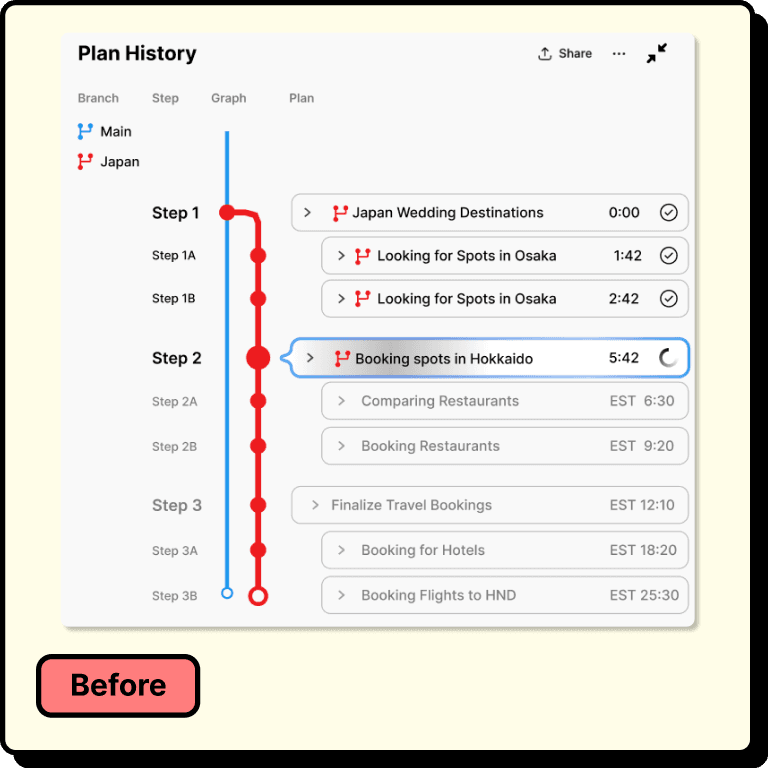
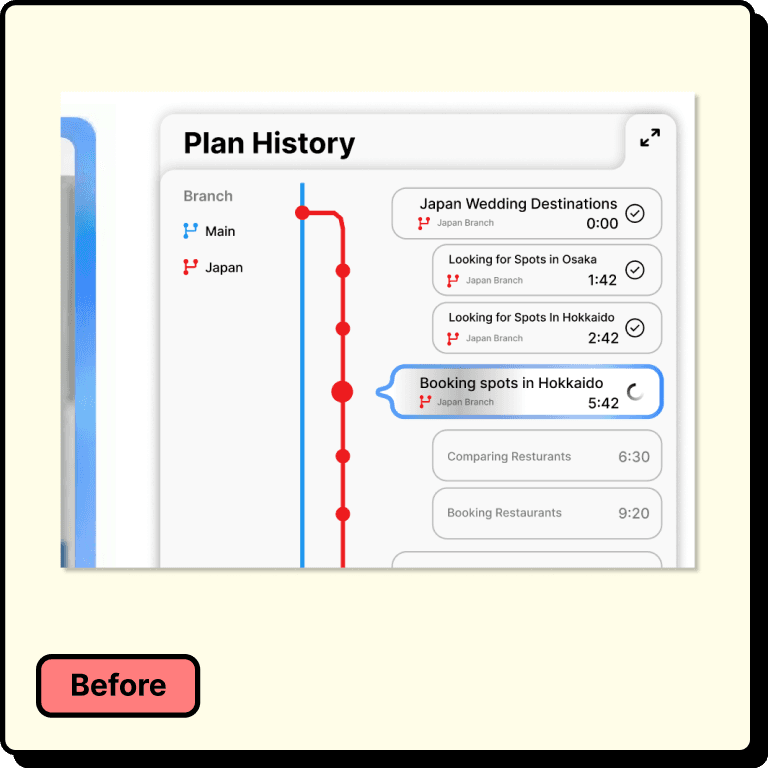
In the past design, branch nodes lacked a state indication for completed or incomplete objectives because nodes were identical. Violating the heuristic of system status visibility.
In the past design, branch nodes lacked a state indication for completed or incomplete objectives because nodes were identical. Violating the heuristic of system status visibility.
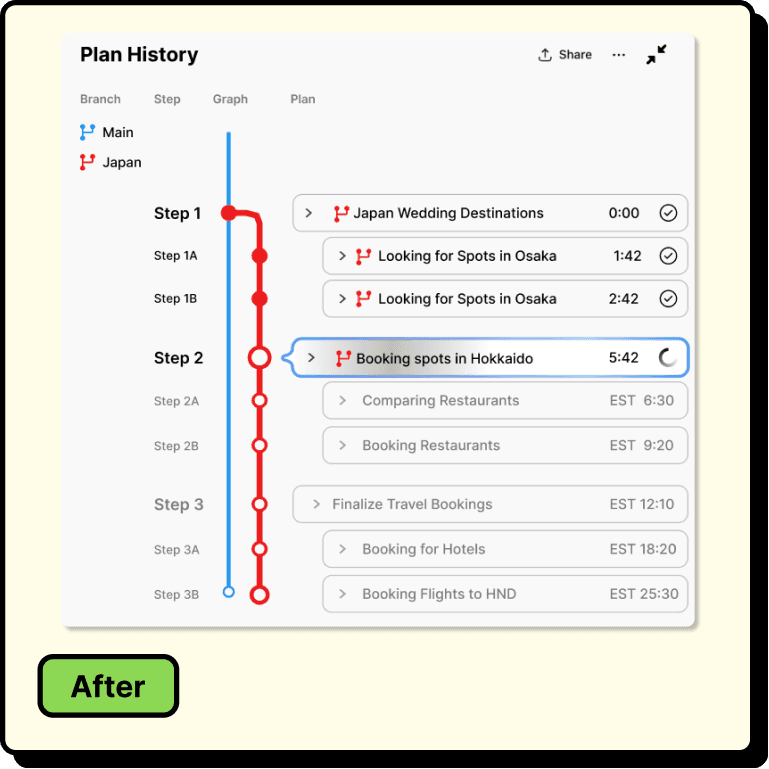
Now, users can see whether objectives are completed. Hollow nodes indicate pending status, while filled nodes are completed objectives.
Now, users can see whether objectives are completed. Hollow nodes indicate pending status, while filled nodes are completed objectives.
reflection
reflection
Takeaways & Thanks.
Takeaways & Thanks.
Takeaways & Thanks.
Looking back, the key takeaway from this project is the value of research. At first, I wanted to jump straight into designs; however, I'm glad we stuck with the first five weeks of literature review; learning how agents work, where existing guidelines fall short, and scoping down the problem space gave me a complete foundation before I touched design. Designing for a problem space with no competitors to reference was a challenge, but that's precisely why the research mattered.
Thanks to our excellent research leads, Kevin Feng and Professor McDonald, and my design peers (Gloria, Amber, Jane), without their constructive feedback, advice during iterations, and vast knowledge on AI agents, I would not have gotten as far as I have. I'm truly grateful to the DRG team for pushing my design limits!
Looking back, the key takeaway from this project is the value of research. At first, I wanted to jump straight into designs; however, I'm glad we stuck with the first five weeks of literature review; learning how agents work, where existing guidelines fall short, and scoping down the problem space gave me a complete foundation before I touched design. Designing for a problem space with no competitors to reference was a challenge, but that's precisely why the research mattered.
Thanks to our excellent research leads, Kevin Feng and Professor McDonald, and my design peers (Gloria, Amber, Jane), without their constructive feedback, advice during iterations, and vast knowledge on AI agents, I would not have gotten as far as I have. I'm truly grateful to the DRG team for pushing my design limits!